There is an undeniable magic to standing beside a truly massive horse. Whether it is a towering Shire, a muscular Percheron, or a stocky, heavy-boned warmblood cross, big horses command a room or rather, a pasture like no other animal.
Choosing the right name for a large equine companion is a unique privilege. A horse’s moniker is more than a simple label; it is an acknowledgment of their physical presence, their unique personality, and their historical lineage.
Throughout history, great warhorses, heavy agricultural draft giants, and legendary mythical steeds have carried powerful names that reflected their immense size and vital cultural roles.
In this comprehensive guide, we move beyond generic lists to bring you an authoritative, highly curated database of big horse names. Every single name featured below includes its origin, meaning, or specific cultural context, allowing you to choose an identity that honors your horse’s scale, heritage, and heart.
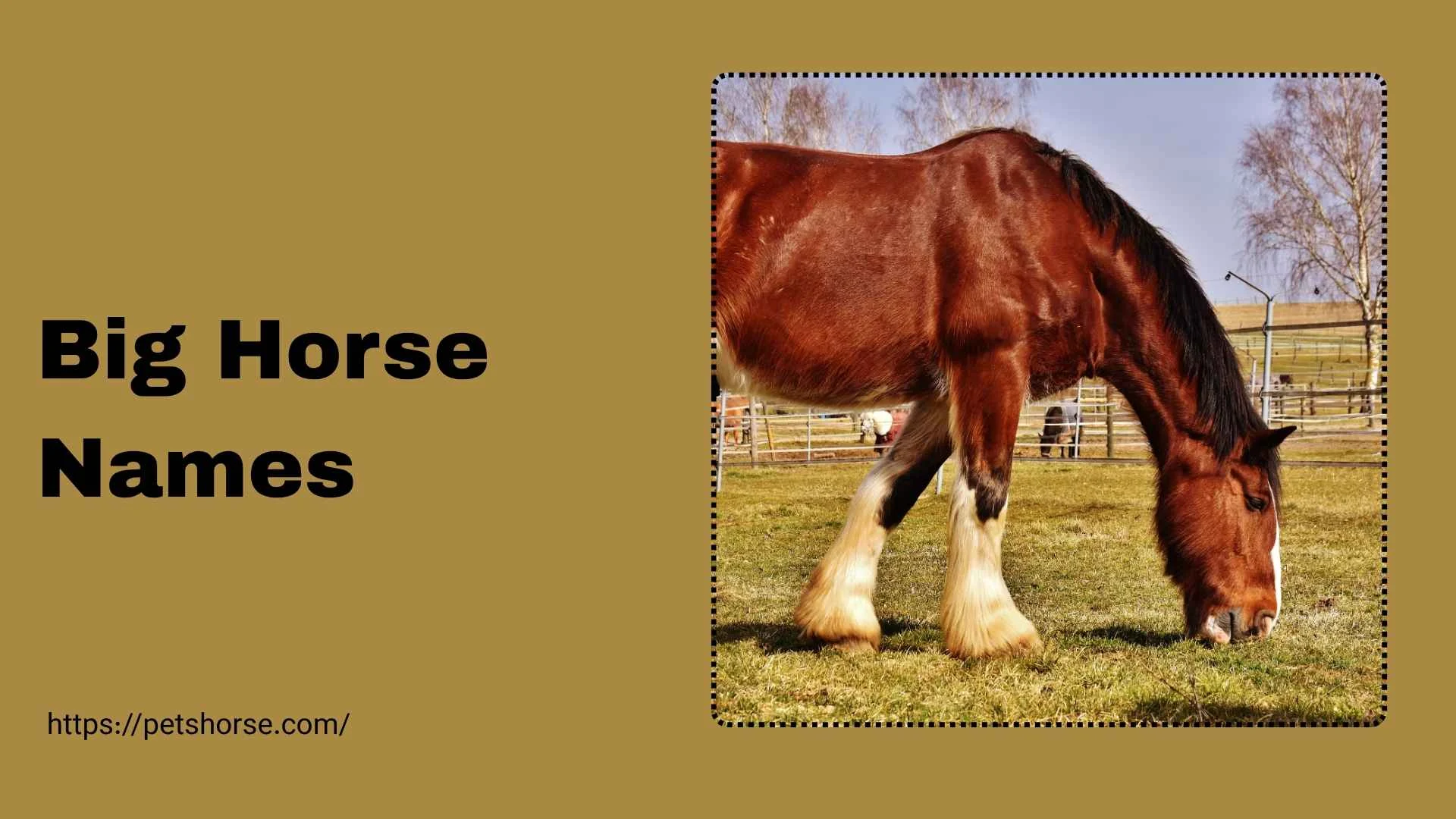
Draft breeds like Clydesdales require names that match their magnificent physical scale.. Source: iStock
Featured Snippet Section
What Are The Best Big Horse Names?
The best big horse names balance a strong physical description with an easy-to-pronounce call name. Excellent options include Titan (Greek for a giant force), Goliath (Hebrew for an imposing figure), Colossus (Greek for a massive statue), and Behemoth (Hebrew for an immense creature). Choose a name that honors both their impressive height and gentle nature.
How Do You Choose The Perfect Horse Name?
- Assess Physical Stature: Consider their specific breed traits, height in hands, bone density, and heavy draft musculature.
- Observe the Temperament: Decide if their disposition matches a bold, powerful name or a soft, “gentle giant” moniker.
- Verify Breed Registries: Ensure the chosen name satisfies character limit rules for associations like the AQHA, Jockey Club, or Clydesdale Horse Society if registering.
- Test the Call Name: Practice saying the shortened “stable name” out loud in the barn to ensure it rolls off the tongue easily.
The Strategic Horse Naming Guide
To land on the absolute best name for a heavy horse, it helps to understand the two parallel tracks of equine naming: stable names versus registered names.
- The Stable Name (Barn Name): This is the functional, everyday moniker you call out when walking into the paddock. It should ideally be one or two syllables, highly distinct in sound, and easy to yell without straining. Horses respond to the cadence and pitch of your voice; a crisp, clear barn name like “Thor” or “Tank” works beautifully.
- The Registered Name: If your big horse is a purebred draft, warmblood, or sport horse, they may need an official name registered with a breed society. These can be up to 18 to 30 characters depending on the association. Registered names often weave in the sire and dam’s lineages, farm prefixes, or elaborate historical references, while the barn name remains a shortened, punchy variation.
When matching a name to a large horse, look to their unique conformation. A broad-chested, 18-hand draft horse might suit an ancient mythological title, while an incredibly fast, heavily built warmblood or field hunter might command a name inspired by geological structures, storms, or industrial power.
Main Name Categories for Large Horses
Powerful & Strong Male Horse Names
These selections emphasize raw power, leadership, muscle density, and undeniable presence.
- Titan – Greek origin. Referring to the primordial deities of incredible strength who preceded the Olympian gods.
- Goliath – Hebrew origin. Meaning “an uncovered or imposing giant”; famously the massive warrior of Gath.
- Atlas – Greek origin. The enduring Titan condemned to hold up the celestial heavens on his shoulders for eternity.
- Magnus – Latin origin. Meaning “the great or immense”; a classic historical name for powerful kings.
- Colossus – Greek origin. Meaning “a statue or entity of gigantic proportions,” famously referenced by the Colossus of Rhodes.
- Behemoth – Hebrew origin. Translating to “beast of monstrous proportions” or a primeval creature of immense power.
- Odin – Norse origin. The all-father of the Norse pantheon, associated with wisdom, sovereignty, and battlefield strength.
- Hercules – Roman mythology. The Roman equivalent of Heracles, celebrated for his superhuman muscle and legendary twelve labors.
- Maximus – Latin origin. Meaning “the absolute greatest or largest in size”; perfect for an exceptionally tall gelding or stallion.
- Gunnar – Old Norse origin. Meaning “bold warrior” or “he who stands firm in battle.”
- Ironclad – English origin. Referencing the heavily armored 19th-century warships; ideal for an immovable, sturdy horse.
- Vader – Dutch/Germanic root. Meaning “father,” popularized as a symbol of dark, commanding, and monolithic authority.
- Bruiser – English descriptive. A name given to individuals of high physical power, tough build, and unyielding strength.
- Gorgon – Greek origin. An entity of terrifying power, symbolizing an intense, fierce, and unblinking presence.
- Sampson – Hebrew origin. Meaning “like the bright sun,” historically representing a biblical judge of extraordinary physical strength.
- Diesel – Germanic surname. Modern terminology denoting heavy-duty machinery, high torque, and industrial-grade power.
- Kratos – Greek origin. The literal personification of strength, might, and sovereign power in ancient Greek lore.
- Taurus – Latin origin. Meaning “the bull,” representing heavy musculature, grounded stability, and immense pulling force.
- Grizzly – North American origin. Referencing the massive, awe-inspiring brown bear of the northern wilderness.
- Khan – Mongolian origin. A historical title meaning “supreme ruler” or “great sovereign,” evoking absolute power.
Majestic & Elegant Female Horse Names
Large mares deserve names that balance their impressive scale with grace, nobility, and classical beauty.
- Athena – Greek origin. The goddess of wisdom, strategic warfare, and handicraft; elegant yet fiercely powerful.
- Freya – Norse origin. The high goddess of love, beauty, and destiny, who also rode into battle to claim her share of heroes.
- Juno – Roman origin. The queen of the gods and protector of the state, representing supreme matriarchal majesty.
- Valerie – Latin origin. Meaning “to be strong, healthy, and full of valor.”
- Olympia – Greek origin. Referring to Mount Olympus, the home of the gods, evoking towering height and heavenly status.
- Rhea – Greek origin. The maternal Titaness known as the “mother of gods,” symbolizing ancient, immense power.
- Hera – Greek origin. The majestic queen of heaven, representing sovereignty, unmatched dignity, and fierce loyalty.
- Valkyrie – Old Norse origin. The warrior maidens who hovered over battlefields, choosing the most heroic fallen spirits.
- Guinevere – Welsh origin. Meaning “white phantom” or “fair lady,” famously the noble and tragic Arthurian queen.
- Bellona – Latin origin. The ancient Roman goddess of war, embodying high-stature military power and fierce elegance.
- Scylla – Greek mythology. A legendary, imposing sea spirit of immense scale and commanding territorial presence.
- Artemis – Greek origin. The untamed goddess of the wilderness, wildlife, and the hunt; noble and independent.
- Freydis – Norse origin. Meaning “noble woman,” historically linked to fearless, strong-willed Viking explorers.
- Isolde – Celtic origin. Meaning “ice ruler” or “she who is gazed upon”; a name steeped in sweeping, tragic romance.
- Minerva – Roman origin. The goddess of wisdom, strategy, and high intellect; an excellent title for a highly intelligent, large mare.
- Andromeda – Greek origin. Meaning “ruler of men,” historically tied to the vast northern constellation.
- Zenobia – Palmyrene origin. The ancient Syrian queen who stood up to the Roman Empire, symbolizing exceptional royal power.
- Danu – Celtic origin. The ancient mother goddess of the Tuatha Dé Danann, representing earth, fertility, and foundational strength.
- Cleopatra – Greek origin. Meaning “glory of the father”; the legendary Egyptian pharaoh known for absolute political power and charisma.
- Sigrid – Old Norse origin. Meaning “beautiful victory,” capturing a blend of striking elegance and formidable power.
Nature & Universe-Inspired Monikers
The natural world provides endless inspiration for massive horses, from colossal geological formations to powerful weather systems.
- Avalanche – French-Alpine origin. A sudden, overwhelming cascade of snow and ice down a mountain; great for a powerful grey or white horse.
- Blizzard – English descriptive. A blinding, intense winter storm of high winds and heavy snow accumulations.
- Canyon – Spanish origin. Referencing deep, massive valleys carved out of solid rock over millions of years.
- Cyclone – Greek root. A massive, rotating storm system of immense atmospheric force and rotating winds.
- Denali – Koyukon Athabaskan origin. Meaning “the tall one,” the official indigenous name for the highest mountain peak in North America.
- Everest – Tibetan/Nepali context. Named after the world’s highest peak above sea level, denoting unmatched height.
- Gale – Old English origin. A highly powerful, sustained wind storm that tests the strength of anything in its path.
- Glacier – French origin. A slow-moving, massive river of dense ice that reshapes entire landscapes through sheer weight.
- Granite – Latin root. An incredibly hard, igneous rock formation that symbolizes unyielding strength and permanence.
- Jupiter – Roman origin. The largest planet in our solar system, named after the supreme king of heaven.
- Magma – Greek origin. The fluid, molten rock beneath the earth’s crust, representing deep, subterranean, boiling power.
- Monsoon – Arabic root. A massive, seasonal wind and torrential rain pattern that sweeps across entire continents.
- Nebula – Latin origin. An interstellar cloud of dust and gas of staggering, light-year-scale dimensions.
- Nova – Latin origin. A powerful astronomical event that causes the sudden, brilliant appearance of a bright new star.
- Obsidian – Latin origin. A dark, heavy volcanic glass formed by rapidly cooling lava; beautiful for a large black horse.
- Quake – English root. Short for earthquake, denoting a force that shakes the absolute foundations of the earth.
- Ridge – Old English origin. A long, elevated geological crest that cuts an imposing silhouette against the sky.
- Summit – Latin origin. The absolute highest point of a mountain peak, representing the pinnacle of achievement and height.
- Thunder – Old English origin. The deep, resonant sonic boom produced by lightning, mimicking the sound of heavy hooves.
- Tsunami – Japanese origin. A series of colossal ocean waves generated by subterranean displacement, carrying irresistible force.
Breed-Specific Names for Heavy Giants
Clydesdale & Shire Horse Names (British & Scottish Heritage)
The native heavy draft horses of the British Isles are famous for their immense feathers, towering heights, and historical roles in commercial transport and agriculture.
| Name | Origin | Meaning / Significance |
| Barclay | Scottish | Meaning “birchwood meadow”; anchors a traditional, proud Scottish agricultural vibe. |
| Sterling | Old English | Meaning “of high quality” or “pure silver”; references the premium nature of a fine draft horse. |
| Fergus | Gaelic | Meaning “man of vigor” or “strong choice”; a classic, rugged highland name. |
| Wallace | Scottish | Honoring Sir William Wallace, the legendary guardian of Scotland who possessed immense stature. |
| Glencoe | Scottish | A historic, scenic glen in the Scottish Highlands known for its sheer rock cliffs. |
| Brampton | Old English | Meaning “town where broom grows”; a traditional, quaint English manor settlement name. |
| Kingsley | Old English | Meaning “from the king’s meadow,” perfectly fitting a noble, high-stepping Shire horse. |
| Angus | Gaelic | Meaning “one strength” or “exceptional choice,” long associated with heavy livestock heritage. |
| Winston | Old English | Meaning “joyful stone,” bringing to mind the stout, unyielding leadership of Churchill. |
| Loch | Scottish | The traditional Gaelic word for a deep, vast lake, evoking a sense of massive scale. |
Percheron & Belgian Draft Horse Names (Continental European Heritage)
Hailing from France and Belgium, these draft breeds are renowned for their incredible bone density, deep chests, clean legs, and heavy pulling power.
- Beauvais – French origin. A historic city in northern France known for its towering Gothic cathedral architecture.
- Gaston – French origin. Meaning “the guest” or “man from Gascony,” bringing to mind a robust, muscular build.
- Brabanter – Belgian origin. A direct reference to the historic Duchy of Brabant, the original home of the Belgian heavy draft horse.
- Ardennes – French/Belgian border. A region of rough, heavily forested hills known for producing ancient, war-hardened draft horses.
- Clovis – Frankish origin. The first king of the Franks, who united the tribes under a single, strong crown.
- Marquis – French noble title. A high-ranking nobleman who governed frontier territories, signifying elite authority.
- Charlemagne – Latin/Frankish. Meaning “Charles the Great,” the Emperor who united much of western Europe via heavy cavalry campaigns.
- Remi – French origin. Derived from Remigius, meaning “oarsman” or “paddler,” requiring great rhythmic upper-body strength.
- Verdun – French origin. A historic, deeply fortified region symbolizing ultimate resilience, endurance, and strength.
- Bordeaux – French origin. A world-famous wine region, perfect for a heavy, rich chestnut or bay draft horse.
Personality-Based Names for Big Horses
The Gentle Giants (Calm, Sweet, and Steady)
Many of the largest horses are incredibly laid-back, affectionate, and careful with their handlers. These names capture that peaceful spirit.
- Barnaby – English/Hebrew origin. Meaning “son of consolation” or “prophet of comfort”; warm and approachable.
- Teddy – Greek root. Short for Theodore (“gift of God”), evoking the comfort of a massive, soft teddy bear.
- Homer – Greek origin. Meaning “pledge” or “security,” denoting a steady, trustworthy horse you can always count on.
- Amos – Hebrew origin. Meaning “burden-bearer” or “carried by God,” reflecting a quiet willingness to carry heavy loads.
- Silas – Latin/Forest origin. Meaning “man of the woods,” suggesting a peaceful, natural, and quiet disposition.
- Otis – Germanic origin. Meaning “wealth” or “prosperity,” often carrying a friendly, slow-moving, and loveable charm.
- Boon – Old French root. Meaning “a favor, blessing, or a good companion” who brings peace to the barn.
- Baloo – Hindi origin. The cheerful, slow-moving, and fiercely protective bear from Kipling’s jungle lore.
- Placid – Latin origin. Meaning “calm, peaceful, smooth, and undisturbed by chaotic surroundings.”
- Gulliver – Irish literary origin. The adventurous traveler who found himself a peaceful giant among tiny people.
Bold, Spirited, & Unstoppable (High Energy)
For the large horse that breaks into a booming canter, kicks up its heels, and shows plenty of forward fire.
- Geronimo – Apache/Italian context. The legendary Apache leader whose name is shouted as a cry of pure courage and momentum.
- Maverick – American origin. Denoting an independent, free-thinking individual who avoids the beaten path.
- Blaze – English descriptive. A bright, intense fire or a rapidly spreading mark of pure energy.
- Rampage – English origin. Meaning to move about wildly, furiously, and with absolute unstoppable energy.
- Vortex – Latin origin. A powerful, whirling mass of water or air that draws everything into its high-velocity center.
- Outlaw – Old English tradition. A non-conformist rebel operating outside standard boundaries, full of grit.
- Havoc – Old French root. A military term signaling widespread, chaotic excitement and energetic movement.
- Wildfire – English descriptive. A rapidly spreading fire that is incredibly difficult to contain or restrict.
- Rogue – French root. An unpredictable, highly independent actor who plays by their own distinct rules.
- Tempest – Latin origin. A highly violent, wind-driven storm that leaves a lasting impression on the landscape.
Famous Big Horses in History and Lore
Looking to history, literature, and mythology can give your horse a name with built-in authority and depth.
- Sleipnir – Norse Mythology. Odin’s legendary eight-legged steed, described as the largest, fastest, and most powerful horse in existence.
- Bucephalus – Ancient Greece. Alexander the Great’s massive, black warhorse, whose name literally translates to “Ox-head,” referencing his broad forehead and immense physical build.
- Brooklyn Supreme – Historical Record. A legendary Belgian draft horse born in the early 20th century who stood 19.2 hands tall and weighed over 3,200 pounds, widely considered one of the largest horses to ever live.
- Sampson (Mammoth) – Historical Record. An 1846 Shire gelding from England who stood an astonishing 21.25 hands high and remains the tallest documented horse in recorded history.
- Xanthos – Greek Mythology. One of Achilles’ two immortal chariot horses, known for being incredibly swift, large, and occasionally endowed with human speech.
- Bayard – French Medieval Lore. A magical, giant bay horse in old French chansons de geste who could adjust his physical size to carry all four sons of Aymon simultaneously.
- Boxer – Literature. The loyal, incredibly hardworking, and powerful cart-horse from George Orwell’s Animal Farm, representing the ultimate dedication of the working class.
- Copenhagen – Military History. The enduring chestnut Thoroughbred-Arabian cross stallion ridden by the Duke of Wellington at the Battle of Waterloo, famous for his incredible stamina.
- Nelson – Military History. George Washington’s large chestnut riding horse, known for his steady nerve under direct artillery fire during the American Revolution.
- Old Billy – Historical Record. A legendary continuous-working English draft hybrid horse who lived to the verified age of 62, symbolizing ultimate longevity and rugged endurance.
Expert Tips for Naming a Large Horse
Choosing a name for your giant equine companion shouldn’t be rushed. To ensure you land on a moniker that ages gracefully, keep these professional tips in mind:
The “Yell Test”: Before finalizing a name, walk out to an empty field and call it out at the top of your lungs. A name like “Behemoth, stop chewing that gate!” is a mouthful. Make sure the name has a simple, natural shorthand (e.g., calling “Behemoth” Bee or Chemo).
- Account for Continued Growth: If you are naming a two-year-old draft cross, keep in mind they do not stop growing upwards or outward until they are five or six years old. A name that feels slightly too big for a lanky youngster will likely fit perfectly once they fill out their massive chest and shoulders.
- Respect the Breed Context: If you own a registered draft horse, look up the naming conventions of their specific registry. For instance, some warmblood societies require the foal’s name to begin with the first letter of the sire’s or dam’s name to visually preserve the lineage in show programs.
- Avoid Phonetic Clashes with Basic Commands: Try not to pick a name that sounds too close to basic ground training cues. For example, naming a horse “Whoa-en” (Owen) or “No-ah” (Noah) can accidentally confuse a young green horse when you are trying to give precise voice commands on the longe line.
Final Horse Name Checklist
Before filling out breed registration paperwork or ordering a custom leather halter plate, run through this final checklist:
- [ ] Is it easy to pronounce? Can your veterinarian, farrier, and barn neighbors pronounce it correctly on the first try?
- [ ] Does it match their personality? Does the name fit their temperament, whether they are a bold powerhouse or a gentle soul?
- [ ] Does it fit their appearance? Does the name visually complement their color, breed markings, and overall conformation?
- [ ] Is it memorable? Does the name stand out in horse show programs or casual conversation?
- [ ] Is it meaningful? Does the historical, cultural, or literal meaning resonate with your values as an owner?
- [ ] Is it suitable for competition? Does it project a proud, professional image in an arena or show ring?
- [ ] Is it family-approved? Is it appropriate for all ages to use around the stable?
Frequently Asked Questions
What are the most popular names for big horses?
The most popular big horse names typically draw from symbols of size and power, such as Titan, Thor, Tank, Goliath, and Maximus. These names are favored because they are easy to yell in a pasture while instantly conveying the animal’s impressive physical presence.
What is the maximum character limit for a registered horse name?
Character limits depend entirely on the specific breed registry. For example, The Jockey Club (Thoroughbreds) limits names to 18 characters including spaces, while the American Quarter Horse Association (AQHA) allows up to 20 characters. Draft registries often allow slightly longer names or prefixes up to 30 characters.
Can two horses have the exact same stable name?
Yes, multiple horses can share identical stable (barn) names. Barn names are unofficial nicknames used around the farm. However, official breed registries have strict rules preventing two identical registered names from being active within the same breed pool at the same time.
What are some good ironic names for a big horse?
If you enjoy a bit of humor, giving a massive draft horse a tiny nickname is a classic option. Popular ironic names include Tiny, Peanut, Bitty, Pip, Minnie, and Cupcake.
How do I choose a name based on a horse’s coat color?
Look for natural entities that match their specific shade. For a large black horse, look to names like Obsidian, Coal, or Midnight. For an imposing grey or white horse, consider Avalanche, Blizzard, or Frost. For chestnuts and bays, names like Copper, Russet, or Bordeaux work beautifully.
Conclusion
Choosing the right name for a big horse means finding a title that matches their physical presence and genuine heart. Whether you choose a classic mythological name like Atlas, a rugged title like Grizzly, or a traditional heritage name like Wallace, the right moniker honors your horse’s unique character. Take your time, get to know their quirks on the ground, and choose a name you will be proud to call out across the pasture for years to come.
Meta Description: Discover 250+ unique big horse names for drafts, warmbloods, and gentle giants. Every single name includes its origin, meaning, and expert selection tips!
Majestic & Ele

 Olivia Carter
 Ethan Williams